Image

When famed American historian and institute namesake John Hope Franklin visited the campus to attend the founding of the Duke Human Rights Center, his comings and goings were in the hands of Mary Williams.
The John Hope Franklin Humanities Institute’s financial manager, Williams has been called the “consummate professional” by many, and escorting Franklin to the university was personally overseen by her to ensure it all went smoothly.
That surety is what fostered a space of support, and it allowed Williams and Franklin to wax poetic about the many ways the university continues to empower its community and its members. It also led to a detour wherein Franklin and Williams toured his famous greenhouse.
Williams’ guidance and overall commitment to the FHI for nearly two decades are key features of the institute's namesake too.
For years, she has been instrumental in helping the FHI administer major programs, like the Humanities Labs and Story+, in addition to taking care of hundreds of guest speakers.
Visitors like Yvonne Mokgoro, who was a justice on the Constitutional Court of South Africa, have left an unforgettable mark on the community of collaborators at FHI thanks to Williams’ unbridled support and care.
When talking about her impact, many partners beyond FHI have only positive remarks.
“Ms. Mary made FHI far more than an office—she made it a place where you always knew there was a safe space to talk,” Erin Parrish Mitchell, executive director of the Human Kindness Foundation, shared. “So much of the joy of working at FHI started and ended in Ms. Mary’s office, over a cold drink, a hot coffee, and a good laugh.”

“My first job at Duke was through the FHI and that was almost 15 years ago,” said Conal Ho, Administrative Reviewer at Duke Health. “Mary was one of the first FHI staff members I knew, and we got along pretty quickly. She captured the respect from all of us and showed the depth of knowledge she has about FHI operations and what is needed to make everyone’s work at the FHI go smoothly.”
Within the FHI, Williams’ impact will continue to be felt by staff, faculty, and administration alike.
“The institute has grown a lot since 2007, and she has been at the heart of it all,” Christina Chia, Associate Director of the FHI, shared. “Hospitality has long been a core value of the FHI and nobody embodies it more than Mary.”
“She has quietly kept us afloat, dealing with so many of the day-to-day elements that make the institute a hospitable place that our students and faculty like to inhabit,” said Ranjana Khanna, Director of the FHI.
“Mary’s smile has a way of dissolving all worries, and somehow, with a sense of ease, she has kept payments going, rooms booked, cupboards stocked and has shuttled all of us and our visitors to where we needed to be. She will be sorely missed.”
The institute has also been able to host countless, impactful local events thanks to Pamela Montgomery, Assistant Director of Finance and Administration at the FHI.
Montgomery’s expertise stems from her career-long commitment to research administration, which built upon her varied experiences in the Duke Medical School, Nicholas School for the Environment, and eventually at the FHI.
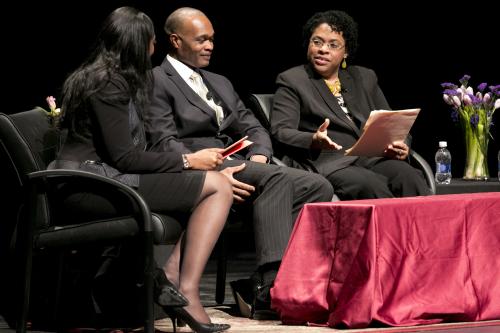
While here, Montgomery helped organize “Reflections on Charleston,” a major public event featuring Jennifer Pinckney, widow of the pastor Rev. Clementa C. Pinckney, who was killed in the June 17th, 2015 shooting at the oldest African Methodist Episcopal Church in the South, “Mother Emanuel” of Charleston, South Carolina.
Pinckney was joined by two of her closest friends, Rev. Chris Vaughn and Duke Divinity School alumnus Rev. Kylon Middleton, Ph.D. Montgomery’s efforts to bring the panel together helped cultivate a space to discuss the violence that targeted the sanctuary, and the challenging trajectory of healing.
Montgomery’s pursuits outside of the institute include being past President of the Southern Section and, before that, North Carolina Chapter of the Society of Research Administrators International (SRAI). SRAI empowers research administrators with professional development, networking, and resources to enhance their expertise and drive meaningful research.
“Pam is a people-person,” Khanna said. “She has always encouraged student-workers, postdocs, and staff to thrive and take advantage of what Duke might offer in terms of their ongoing advancement.”

“Her expertise with research grants has been vital for the FHI over the past decade, enabling us to bring students, faculty, external partners, and community participants together in innovative collaborations,” Chia reflected, noting her contributions to a succession of Mellon Foundation grants and the recent NEH SNCC and Grassroots Organizing initiative.
Montgomery’s administrative experience and civic commitments also proved critical to the Duke Human Rights Center, particularly its partnerships with the Pauli Murray Center and MacArthur Award-winning environmental advocate Catherine Flowers.
With the FHI bidding farewell to two of its key members, they leave behind indelible marks on a community they helped thrive through impactful collaborations, thoughtful events, and meaningful change in how they engaged with their colleagues.
